Translate

Thursday, 9 June 2016

My World


I see things that most people do not: A different world underwater.


This is my world.

But my world is being destroyed. The ocean is dying. I have seen first hand the after effects of what we have done, how we are ruining it. Water is what differentiates our planet from any other and facilitates life. No ocean, no life. We call this world planet earth, but seven tenths of the world’s surface is covered by water and over 80% of life on earth lives in the ocean. Life on earth evolved from the sea. We all come from the sea, but we are not all of the sea.


There are those who have never seen these creatures in the wild. They see them in their bank accounts. They profit from the destruction of our oceans. 


They take exactly what they want with no thought or respect for the impact it will have.


But we depend on the oceans. They hold 97% of the planet's water, produce more than half of the oxygen in the atmosphere and absorb the most carbon from it. Over 2 billion people rely on the oceans for their primary source of food. Destroying the ocean is threatening everything that lives in it.

Sharks are just one of the species that are in real danger. But ironically, society has taught us that sharks that are dangerous and you grow up believing it. But when you see the very thing you were told to fear underwater: it’s absolutely incredible. If sharks were the evil, deadly man eaters that the media sensationalises them to be, then I would have probably been eaten years ago.

However, I believe that sharks know we are not prey. Millions of people swim every year in waters where sharks hunt all the time. If they wanted to eat us they would, but they don’t.


Swimming with sharks I feel vulnerable, clumsy and small. They have an aura of invincibility, but nothing is as it seems. Sharks are in serious trouble. Every single second of every single day around 3 sharks are killed by us. With 90% of the world's shark populations already wiped out, sharks are being depleted faster than they can reproduce and if an apex predator is taken out of any ecosystem then eventually it is going to collapse. Sharks are vitally important; they have shaped life in the ocean for over 400 million years. Sharks kill 5 people each year. We legally execute 2,400 people a year and kill 100 million sharks. Is it really sharks that we should fear? Don’t fear them. Fear for them.

I believe that future generations are going to look back on us as barbarians, in the same way we now look back on slave traders.We are driving species to extinction and the worst part is that we know what we’re doing and yet we’re still allowing it to happen. I just hope that by the time people finally see sense, it isn’t too late, the damage isn’t irreversible and we aren’t faced with the extinction of species.

People protect what they love, this is what I love and I’m determined to fight for it. I want future generations to grow up to be able to experience the same ocean that I have. But if this carries on, in the next 4 years 30% of known species of sharks and rays could become extinct. Once they’re gone we’ve lost them forever. We will have to carry that on our conscience; it will be the fault of mankind. We have caused these problems, now it is our duty to fix them.

People don’t see what goes on in the oceans so it’s easy for them to ignore. They wanted to save bears, leopards and elephants; mankind was afraid of sharks and creatures of the deep. However I believe that if others had witnessed what I have seen in my lifetime from hundreds of hours underwater, I would not seem outspoken at all.


Tuesday, 7 June 2016

Are you sitting comfortably? Don't. Life is short


People constantly aspire to have more; to be wealthier, own more possessions and get promotions, which is crazy when you think that there is someone out there who is aspiring to just have what you already do. There are always those better off and worse off than you. Remember that.

I was lucky to have been born in a developed first world country, to have; not just education, food and clean water every day, but also so many opportunities. I'm far from the wealthiest person I know, but I still have so much, I am extremely fortunate. I don't know why I was born into these circumstances and not different ones, but I do know that I definitely won't take it for granted.

I have been that girl; working two jobs, seven days a week just so I can afford to cover my costs. I was literally working to afford working. However, unlike many of my peers, I now refuse to work a job I don't like just to make money, to carry on living a life that I'm unhappy in.

So people should not aspire to materialistic goals. They should strive to improve themselves in some way; making money doesn't equate to making yourself better. Travelling changed my life. My mindset used to be all about money. Although, it wasn't really MY mindset; I was just a product of the society I was raised in. Aspiring to make money and orientating everything around that is what is expected from you as a responsible adult, and is just viewed as being the social norm.

I had myself lined up a successful career based on the hard years spent working to get my degree, but then I boarded a plane to travel the world working as a dive instructor instead. I defied the stereotypical expectations people held of me which was the best decision I ever made.

I quickly came to realise that making money was most certainly not the most important thing in life, not for me anyway. Now I would gladly live out of a suitcase; sacrificing material possessions for life-altering experiences.


So, don't waste your life aspiring for things that can only be measured in materialistic success because, "Life isn't about how many breaths you take, but the moments that take your breath away."


Friday, 6 November 2015

Scuba Diving in Grand Cayman

Having worked in Grand Cayman as a dive instructor for nine months, there isn’t much I don’t know about the diving there. Whether you’re planning a dive trip to Grand Cayman, considering whether to try diving there or are just curious as to what it is all about, this post is for you.
Grand Cayman is revered as one of the top diving destinations in the world, and it’s not hard to see why. With a drop off to over 4,000ft underwater around the island, it is only a five minute boat ride to access deep dive sites. The reason for this is that the island sits on top of an underwater mountain so it is entirely surrounded by deep water and pelagic marine life.
Balloon Fish
Balloonfish
The marine life inhabiting the waters around the Cayman Islands makes it a dream diving destination for avid divers and novices alike. The ocean ecosystem is so diverse, top to bottom, that it makes every dive such a rush. From as soon as you drop below the surface, right down to the bottom, there is life worth seeing every step of the way regardless of how deep you go.
Common Reef Octopus hiding on the bottom
Common Reef Octopus hidden in the reef
Depending on the wind and wave conditions you can often find large mats of sargassum weed on the surface. This weed is home to frogfish, nudibranchs, seahorses, crabs, shrimp and many different species of juvenile fish, and was my favourite spot to start and end my dive as I could hang out with the predators underneath. The mid-water column houses a full range of tiny, colourless microorganisms, invisible until they cruise by your mask with the much larger ctenophores (comb jellyfish), tunicates and salps following suit.
Poppy's favourite- Porcupine Fish-
Porcupine Fish
The reef ecosystems in Cayman are an excellent example of what a healthy reef should look like and the coral in particular is extremely healthy. From the brain and boulder corals that build the reefs to the gorgonians and sea fans that baffle nutrients down onto the substrate beneath, it everything about the reef seems alive and well. Just the sheer number of different creatures you can see on a single dive never makes for a dull moment. The reefs are covered with parrotfish, grunts and snapper taking shelter amongst the coral below the schools of chromis and wrasse venturing up in the water column above them. Every crag and pore in the reef holds some sort of interesting organism; lobsters, large clinging crabs and eels being the usual suspects.
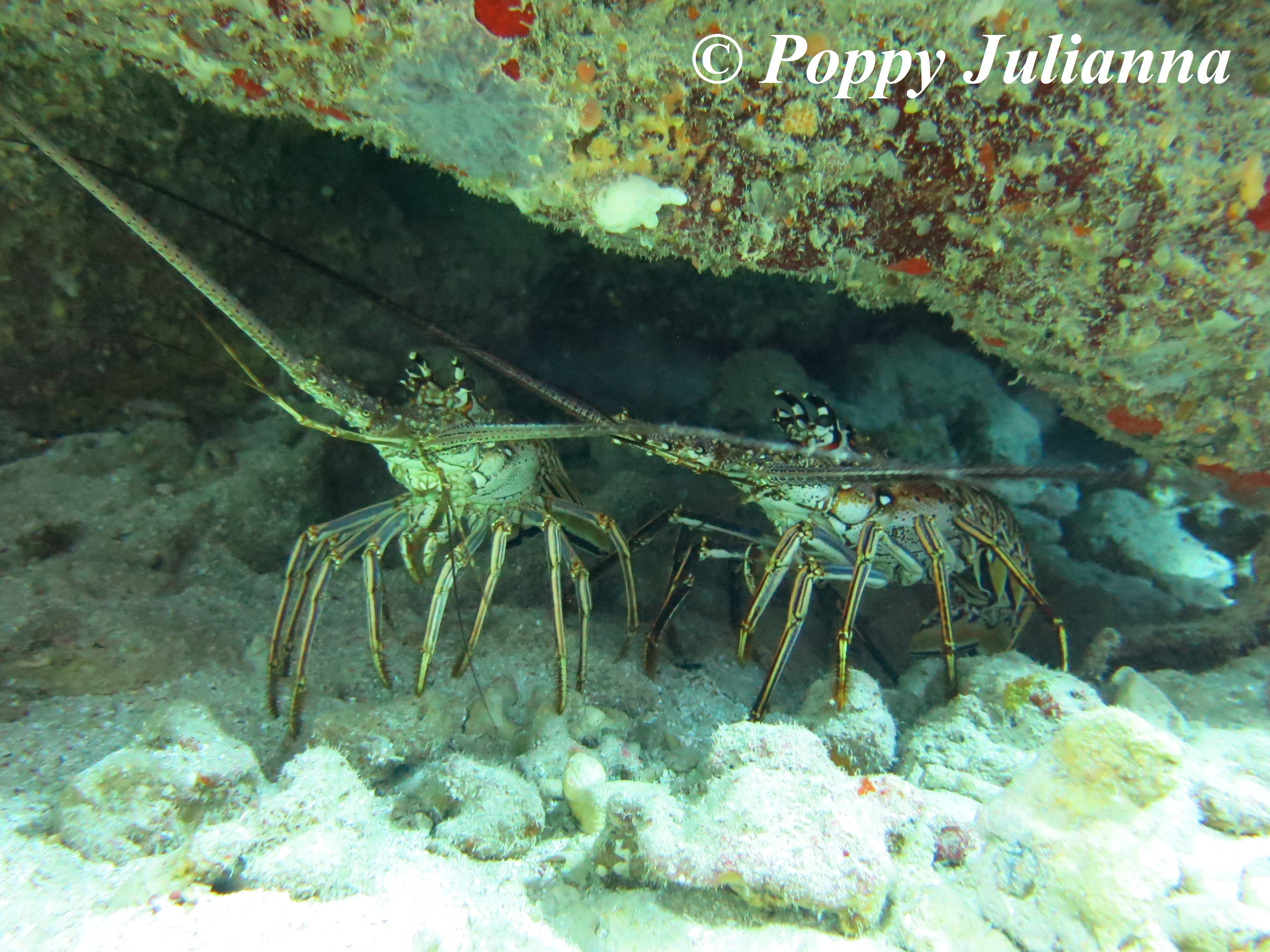
Caribbean Spiny Lobster
My favourite part of every dive was the contrast between the reef creatures and the sand habitat surrounding the coral fingers. This is where you would find hogfish, southern stingrays and spotted eagle rays snarfing around in the sand looking for their daily meals amongst the beds of garden eels and rubble piles that house sand tilefish.
Female Southern Stingray
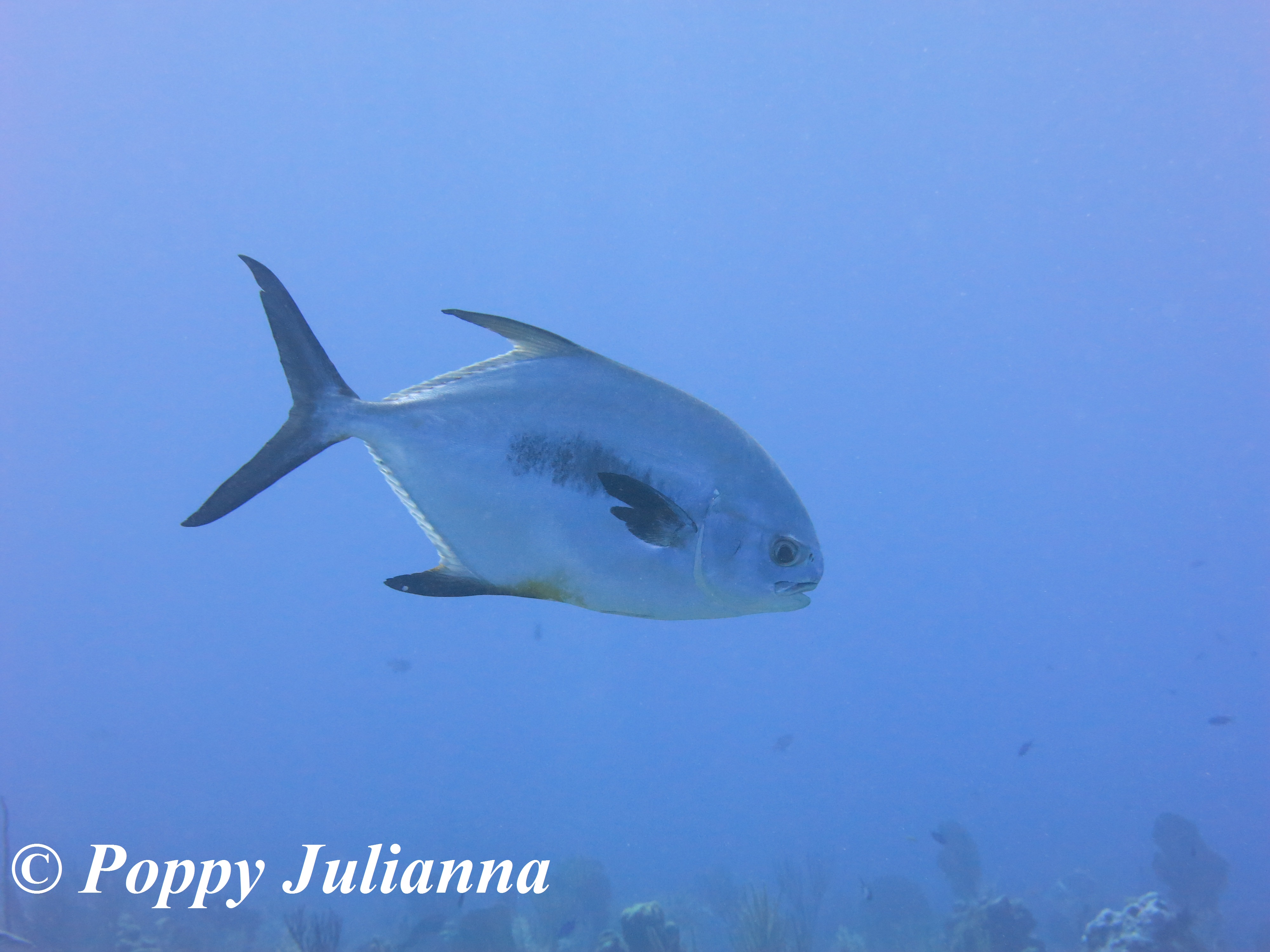
My favourite fish are the large, predatory pelagic fish that come up from the water water off the wall and cruise into these areas. The sinewy, silver type that make one close pass to inspect you and are on their way, i.e. the permit, amberjack and african pompano that fly by without giving you the chance to prep your camera.
Permit Fish
 Permit Fish
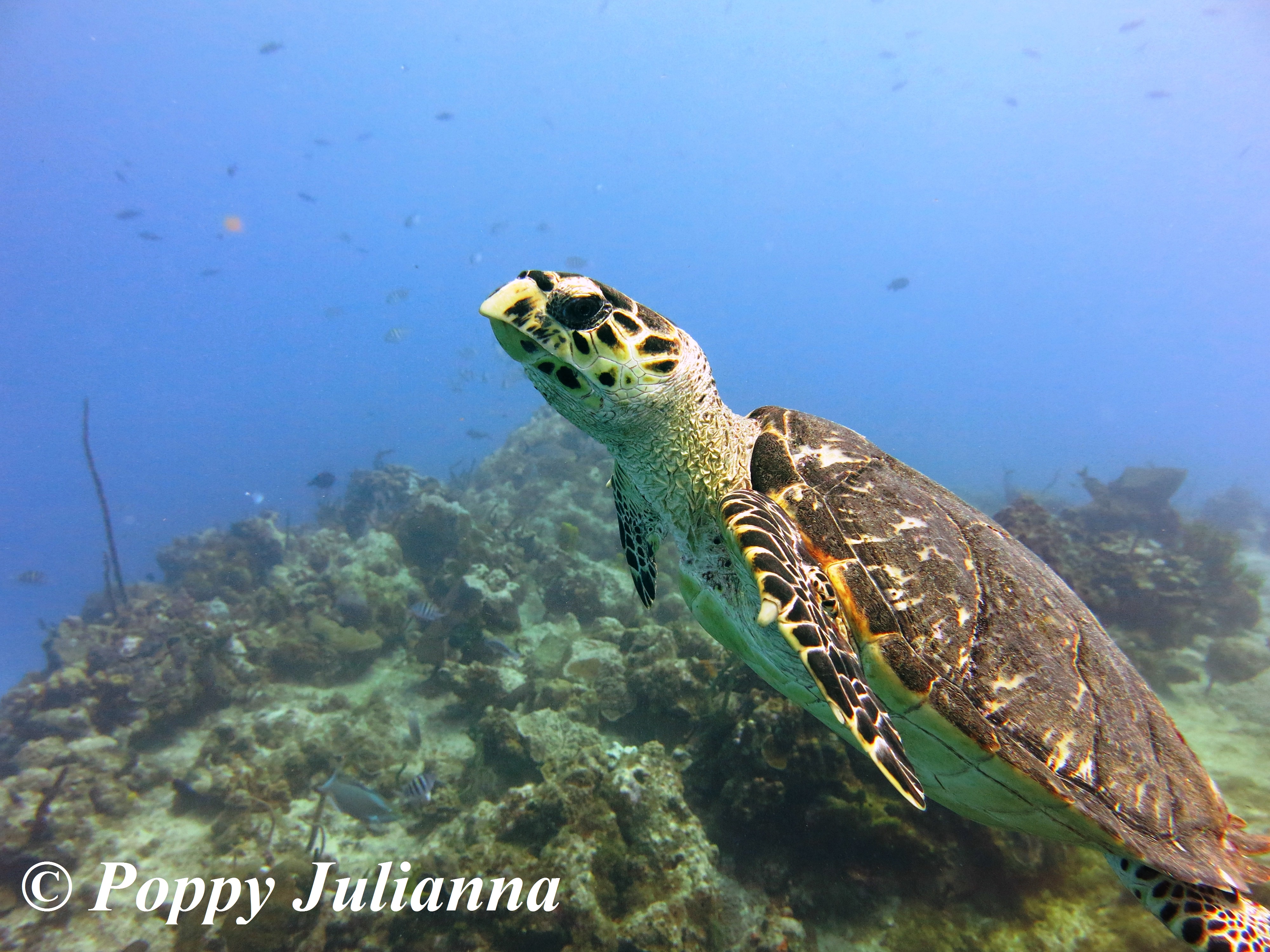
Found amongst all of this are what Cayman is most famous for: sea turtles! I would say I saw at least one turtle on eighty percent of the dives we did there. If not on the dive then we would definitely see one popping up from the reef on the way in or out.
IMG_0158
Hawksbill Sea Turtle
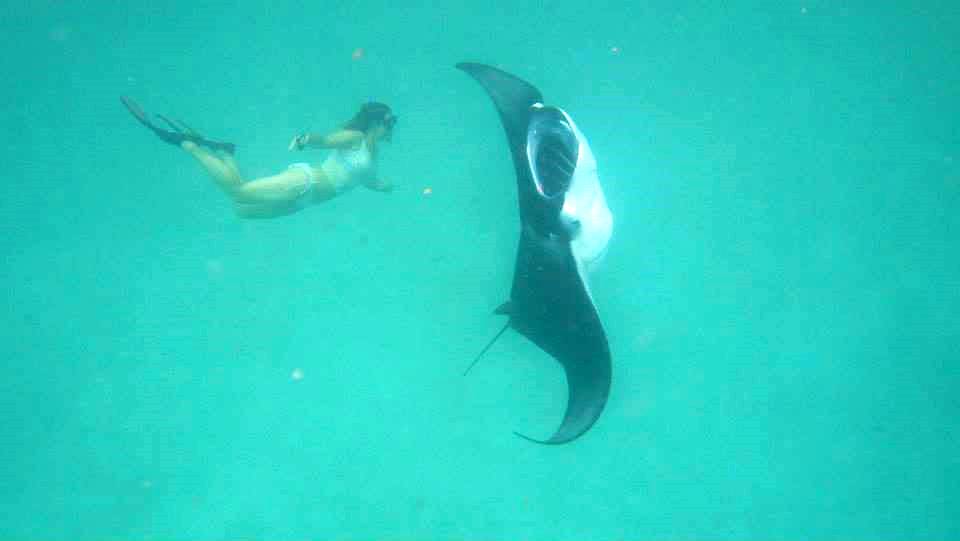
Hawksbills are the most common sea turtle with loggerheads heading by every now and then in the spring and summer. Green sea turtles are also very common in a few specific areas of the island. As far as the larger marine life goes, we did run into some sharks every now and again which always gave us something to talk about for the next week or so. While nurse sharks are common, the occasional caribbean reef shark or hammerhead could also be seen. Their cousin, the manta ray, was also spotted in a few rare instances. If you want my advice and are able to make the trip, then grab your gear and jump in. You won’t regret it.

Tuesday, 21 July 2015

A far more accurate portrayal of Mick Fanning's "shark attack"...


I believe that Fanning was not attacked at all. The shark's tail fin is what can be seen thrashing at the surface, pointing at a downward angle. This is indicative that the shark simply got caught in his surfboard leash and then panicked so attempted to swim downwards with Fanning still attached to the leash. However, as soon as the leash broke Fanning was released and unharmed. 

If it was an attack the shark would have approached at an upward angle under the board, but it was simply curious as to what Fanning was. It frustrates me that the media have yet again sensationalised and embellished this story to evoke fear and hatred for sharks. In fact, it was a missed opportunity for a positive story demonstrating how sharks don't necessarily target and attack people, this was a simple entanglement accident, not an attack.

However, I do applaud South Africa for not reacting to this incident with kill orders and culls, like is happening in too many other parts of the world.


Saturday, 4 July 2015

Why I wear pink fins

Most people assume that I wear pink fins and have pink diving accessories because, obviously,  I'm a cliche girly girl. In fact the reason is totally the opposite. I wear pink precisely because I'm not usually perceived to be a girl at all; to mark my female identity and redeem a sense of femininity in a predominantly male orientated industry. 

I'm not sure why, but the colour pink seems to be synonymous with female identity, so my using of the colour pink is an attempted reminder that I am, in fact, a girl. I have always been happier to go catch some waves or play beach sports with the guys than to lie on the beach sunbathing, but in doing so I have been accepted and treated like one of the boys, because 'most girls don't act like that.' 

I want to break down these gender barriers and stereotypes that dictate what is and isn't socially expected from girls. Working as a dive instructor I have unfortunately experienced countless sexist remarks and people's archaic views on the 'woman's place' first-hand.It used to be considered bad luck to have a woman on board a boat because they distracted the sailors from their sea duties. Thankfully we've come a long way since then and I am qualified to drive, crew and work on boats just as my male counterparts are. However it seems that some people's views have not moved with the times.

I often receive condescending comments about wearing pink fins; however I would rather accept these sweeping generalisations and assumptions of fitting a stereotype than to be forgotten as a female. What I struggle to accept though, is people assuming I will be inferior to my male colleagues; an opinion purely determined by my gender. Or people presupposing that I am just a deck hand or intern because they don't expect a girl to have a career teaching people to scuba dive. 

What frustrates me the most though is when people are surprised if I actually do a good job: I want to be seen as good at my job because I'm a girl, not despite it.

However, this gender stereotyping can even be extended to colleagues and employers. I have worked in several dive jobs where women are encouraged to work in the shop and let the men do the heavy lifting and filling of tanks. Is equality so much to ask for in first world society in the twenty-first century?

For a while I tried to suppress my female identity and fit in with the guys, in order to be treated as an equal, but to no avail. The guys I worked with used to hide or use my dive equipment 'as a joke' because I was the only girl, and so by default, the only target. I am all for a bit of fun in the workplace, but it gets tiresome when you become the target for all pranks, solely due to your gender. So I bought pink fins to embrace the fact that I am a girl, but to be respected and not targeted for being one. It seemed to work, apparently most guys don't want to be caught dead diving in bright pink fins.


Meet Kiki the nurse shark

Here in Grand Cayman we have a friendly neighbourhood nurse shark called Kiki who absolutely loves divers and often joins us on our dives.


She has the temperament of a labrador puppy and will swim right alongside divers, sometimes even brushing up against them. It is important that divers resist the urge to reach out and pet her though, however tempting it may be, as humans have all kinds of grease and bacteria on their hands which if transferred onto a shark's skin can be harmful to them.


Nurse sharks can reach up to 14 feet in length and weigh up to 750lb. Kiki however is around 5 feet long.


We know it is Kiki when we see her, not only from her behaviour but she also has a scar in her lip where she was once hooked on a fishing line.


Nurse sharks are generally a nocturnal species, however Kiki seems to be active all through the day, choosing to hang out with divers over sleep!